
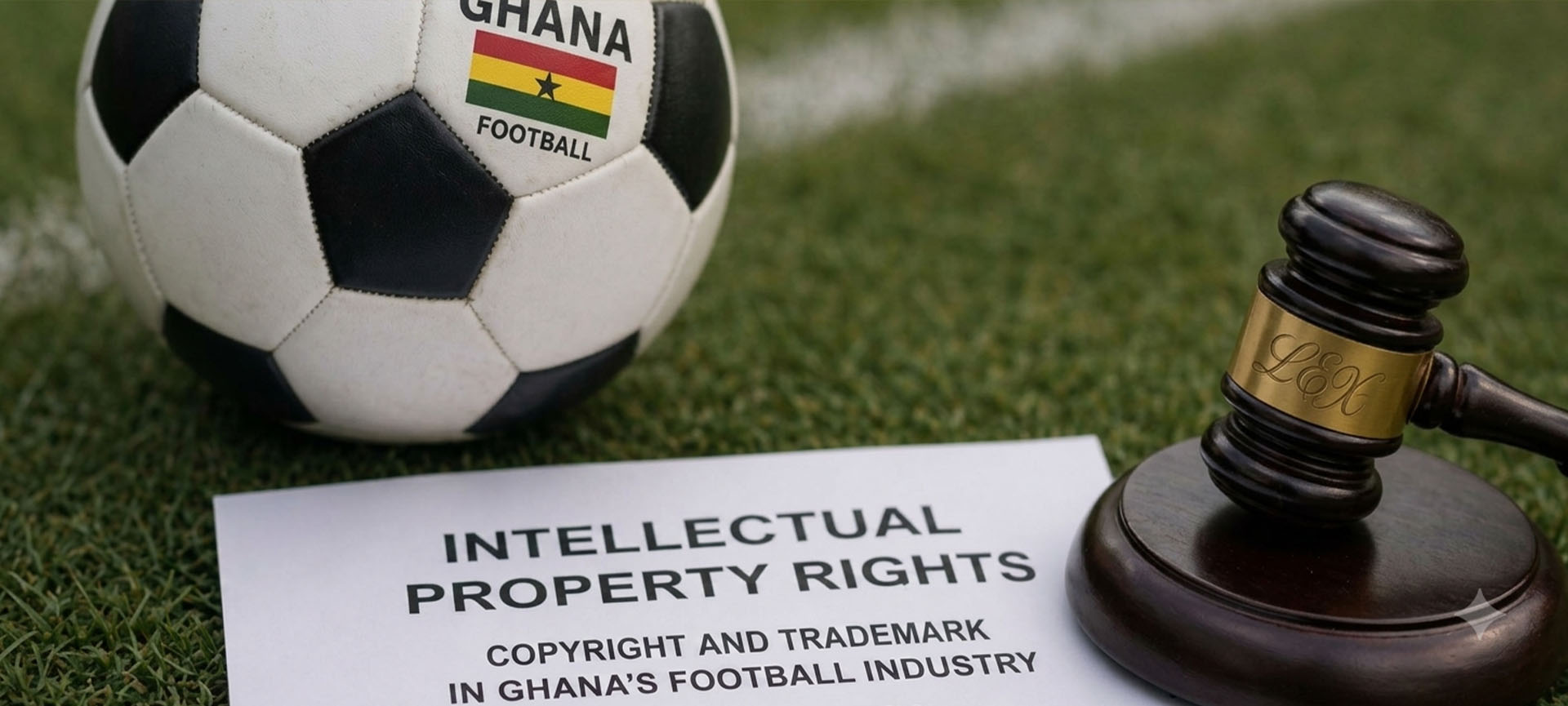
30 Jul Protecting The Beautiful Game: Intellectual Property Rights In Ghana’s Football Industry
INTRODUCTION
Sports at its core is a display of human performance; the thrill of competition, the agony of defeat and the joy of victory. But behind every sporting activity, every sponsorship banner and every jersey sold lies a sophisticated and often underappreciated legal ecosystem: Intellectual Property (IP) law.
The World Intellectual Property Organization (WIPO) marked the 2026 edition of World IP Day, under the theme, “IP and Sports: Ready, Set, Innovate!”, celebrating how creativity and innovation, backed by IP rights, keep the world of sports thriving, dynamic, and accessible for everyone, everywhere.[1] For Ghana, the stakes are equally real. The country’s football clubs, governing bodies, and sports entrepreneurs are sitting on a wealth of brand equity; names, crests, slogans, and identities that inspire fierce loyalty among millions of fans. Yet the legal frameworks that should protect these assets remain poorly understood and inconsistently enforced. It is not merely a legal issue, but a daily commercial reality that undermines revenue generation, brand value, and the long-term growth of the industry.
This article examines the intersection of Intellectual Property (IP) and Ghanaian football, with a particular focus on trademark and copyright protection. It explores the types of IP at play in the football industry and the nature and consequences of infringement of these rights.
UNDERSTANDING INTELLECTUAL PROPERTY IN FOOTBALL
Intellectual property refers to creations of the human mind[2] that are accorded legal protection, giving their owners exclusive rights to use and exploit them commercially for defined periods. The concept rests on a simple but powerful premise: that creative and inventive effort deserves recognition and reward, and that without such protection, the incentive to innovate would be significantly diminished.
Ghana’s IP legal framework aligns with international standards through agreements like The Berne Convention, the WIPO Copyright Treaty, the TRIPS Agreement, the Paris Convention and the Madrid Protocol.[3]
TRADEMARK PROTECTION IN FOOTBALL
Football related trademarks protect the unique branding elements of athletes, teams, and leagues, including names, logos, slogans, mascots, and colours. In practical terms, the following elements of a football club or competition constitute trademarks capable of registration and protection:
Club names are the primary identifier of football clubs. The names “Asante Kotoko S.C” or “Accra Hearts of Oak S.C” carry decades of goodwill, history, and emotional attachment. Under the Trademarks Act, 2004 (Act 664), such names may be registered as word marks, entitling the owner to prevent others from using identical or confusingly similar names in the course of trade.[4]
Club logos and crests are visual trademarks and, perhaps the most immediately recognisable IP asset a football club possesses. The porcupine of Asante Kotoko and the eponymous oak tree of Hearts of Oak are commercial assets that appear on merchandise, kits, marketing materials, and digital platforms worldwide. Unauthorised reproduction of these crests constitutes trademark infringement.
Team slogans that have been formally adopted and consistently used by clubs may also acquire trademark protection where they distinguish the club’s commercial activities.
The primary legal basis for trademark registration and protection in Ghana is the Trademarks Act, 2004 (Act 664), as amended by the Trademarks (Amendment) Act, 2014 (Act 876).[5] Trademark owners must generally register their marks before enforcing rights in Ghana.[6] However, certain trademarks are classified as well-known marks and do not need to be registered for protection. For established clubs like Asante Kotoko and Hearts of Oak, whose names and crests are widely recognised across the African continent, the well-known marks doctrine may provide some protection even without formal registration, though registration remains strongly advisable.
Trademark Infringement in Ghanaian Football
Trademark infringement occurs when a person uses, without authorisation, a sign that is identical or confusingly similar to a registered mark in relation to identical or similar goods or services, in a manner likely to deceive or confuse the public.[7] In the Ghanaian football context, infringement takes several forms:
Counterfeit football jerseys represent the most pervasive and commercially damaging form of trademark infringement. Counterfeit jerseys bearing the crests of Kotoko, Hearts of Oak, the Black Stars, and international clubs are openly available across major markets in Ghana, sold at a fraction of the price of legitimate merchandise, and without any royalty reaching the clubs whose brands they exploit.
Unauthorised use of club logos on printed materials, digital content, social media accounts, and marketing collateral without the consent of the club constitutes infringement even where no physical goods are involved. The consequences of infringement extend beyond immediate revenue loss. Brand dilution, which constitutes the gradual erosion of a mark’s distinctive character through widespread unauthorised use, poses a long-term threat to a club’s commercial value and sponsor relationships.
COPYRIGHT PROTECTION IN GHANAIAN FOOTBALL
Copyright is a right that creators have over their literary and artistic works. While the rules and the act of playing football cannot be protected by copyright, many of the creative and commercial elements surrounding the game are protected under the Copyright Act, 2005 (Act 690) (the “Copyright Act”).
In Ghana, copyright protects original works once they are created and recorded in a tangible form. This means there is no need for formal registration, although registration can be useful in proving ownership in the event of a dispute.[8]
Several types of football-related content are protected by copyright in Ghana. Match broadcasts, whether live or recorded, are protected as audiovisual works. This also applies to highlight reels, documentaries, and other digital video content. Photographs taken during matches or football events are protected as artistic works, while music associated with football such as theme songs, jingles, and tournament anthems are protected as musical works.
Copyright includes two main rights; economic rights – which allow the owner to obtain financial benefits from their work (e.g., licensing)[9] and moral rights -which protect the creator’s connection to the work, such as being credited as the creator of the work.[10]
The Copyright Act provides various penalties, including payment of fines and terms of imprisonment for copyright-related offences.
Copyright Infringement in Football
Match Broadcasting Rights
Broadcasting rights are one of the most significant sources of revenue in football. These rights authorise broadcasters to transmit football content across television, radio, and digital platforms. They may cover live matches, delayed broadcasts, or highlight packages. There are three main types of sports broadcasting rights: television rights, radio rights and streaming rights.
Football leagues and associations typically own and manage these rights. In Ghana, the Ghana Football Association plays a central role in regulating football and managing its commercial interests. This includes negotiating broadcasting deals, securing sponsorships, and ensuring proper organization of football activities.[11] Broadcasting rights are often sold for substantial sums. For instance, the Premier League sold its 2025–2029 broadcasting rights for approximately £13.2 billion,[12] underscoring the immense economic value of football media content. Revenue from such deals helps fund major sporting events, improve infrastructure such as stadiums, and support grassroots football development.
Broadcasting rights are often sold on a territorial basis. This means content may only be shown in specific countries or regions under exclusive agreements. To enforce these restrictions, platforms use geo-blocking technology, which limits access based on a user’s location. As a result, some content may not be available in Ghana, and users may receive notifications stating that the content cannot be accessed in their location.
Photography and Match Images
Every match generates a wealth of photographic content such as action shots, goal celebrations, crowd scenes, and portrait images. These images are generally protected by copyright. The photographer who captures the original image generally owns the rights to that photograph, including the exclusive right to reproduce, distribute, and display it publicly.[13] Using match photographs in advertising campaigns or publishing them in digital media requires permission from the copyright holder.
Club Anthems and Stadium Music
Music is woven into the fabric of football culture. From the famous UEFA Champions League anthem to the official World Cup anthems, music plays a powerful role in creating the match-day atmosphere. This music is protected by copyright, and its public performance requires appropriate licensing.
Social Media and User-Generated Content
Social media has transformed how fans engage with sport and created one of the most contested frontiers in sports copyright law. Fans routinely record match footage, post goal clips, create highlight compilations, and share reaction videos. This content significantly amplifies a club’s reach and visibility; however, where it is used without proper authorisation, it may constitute an infringement of copyright.
Act 690 provides certain permitted uses, including for purposes of criticism, review, or news reporting. Such use must be accompanied by acknowledgment of the work and its author, and must not conflict with the normal exploitation of the work or unreasonably prejudice the legitimate interests of the copyright owner.
The unauthorised live streaming of football matches, the circumvention of geo-blocking restrictions through tools such as VPNs, and the creation of unlicensed highlight compilations all constitute clear infringements of copyright under Copyright Act, 2005 (Act 690), as they involve the unauthorised reproduction and communication of protected content.
Similarly, the commercial use of match photography without the consent of the photographer violates the exclusive rights of the copyright owner. In the same vein, incorporating match footage into advertising campaigns without proper licensing amounts to unlawful exploitation of audiovisual works.
Collectively, these practices undermine the commercial value of broadcasting and media rights and interfere with the lawful interests of rights holders.
CHALLENGES IN PROTECTING TRADEMARKS AND COPYRIGHTS IN FOOTBALL.
Despite the existence of strong IP laws, Ghana faces several challenges.
Unauthorised streaming of matches is a growing concern, particularly with the rise of digital platforms. These illegal streams reduce the revenue broadcasters earn from their exclusive rights, thereby lowering the overall value of those rights and weakening the financial benefits they bring to the football ecosystem.
Another major issue is weak enforcement. Limited resources and enforcement capacity make it difficult to take effective action against infringement. This affects the revenues of leagues, broadcasters, clubs, and other stakeholders. It also allows piracy and counterfeit merchandise to thrive, which damages brand value and discourages innovation. In addition, many clubs, players, and fans lack sufficient awareness of intellectual property rights and their importance.
Addressing these challenges requires stronger enforcement, better education, and greater collaboration among stakeholders.
CONCLUSION
Intellectual property is no longer a peripheral issue in football, it is central to how the beautiful game is financed, managed, and commercialized. The legal framework for both copyright and trademarks provides a solid foundation for protecting the valuable assets that surround the sport. However, the effectiveness of these laws depends on how well they are understood, enforced, and integrated into everyday football operations.
Improving awareness and strengthening enforcement will help reduce incidents of football-related copyright infringement. In turn, this will protect revenue streams, enhance brand value, and create a more attractive environment for sponsors and investors.
As global events such as the recently concluded FIFA World Cup 2026 demonstrate, the commercial importance of intellectual property in football will only continue to grow. Ghana has a strong football culture and valuable brands. With the right focus on intellectual property protection, the country is well positioned to unlock greater economic value from the game and secure a more sustainable future for its football industry.
Authors: Adjoa Owusu-Mintah
[1]World Intellectual Property Organization, ‘World IP Day 2026: IP and Sports: Ready, Set, Innovate!’ <https://www.wipo.int/en/web/ipday/2026/index > last accessed 29th July 2026.
[2] <https://www.wipo.int/en/web/about-ip> last accessed 16th April 2026.
[3]The Berne Convention for the Protection of Literary and Artistic Works (1886); Paris Convention for the Protection of Industrial Property (1883); WIPO Copyright Treaty (1996); Madrid Protocol Relating to the Madrid Agreement Concerning the International Registration of Marks (1996).
[4] Section 1 of the Trademarks Act, 2004 (Act 664).
[5] ibid s 3. See also Trademarks (Amendment) Act, 2014 (Act 876).
[6] Section 9 of Act 664.
[7]Section 26 of Act 664.
[8] Section 39 of the Copyright Act, 2005 (Act 690).
[9] Ibid, Section 5
[10] Ibid, Section 6
[11] https://www.ghanafa.org/tv3-and-onua-tv-named-official-broadcast-partners-for-2025-26-premier-league
[12] The Analysis Series: The English and Major European Football Broadcast Rights Market
By Paul Quinn https://theesk.org/2025/08/15/the-analysis-series-the-english-and-major-european-football-broadcast-rights-market/> last accessed 12th April 2026
[13] Section 1of the Copyright Act, 2005 (Act 690)