

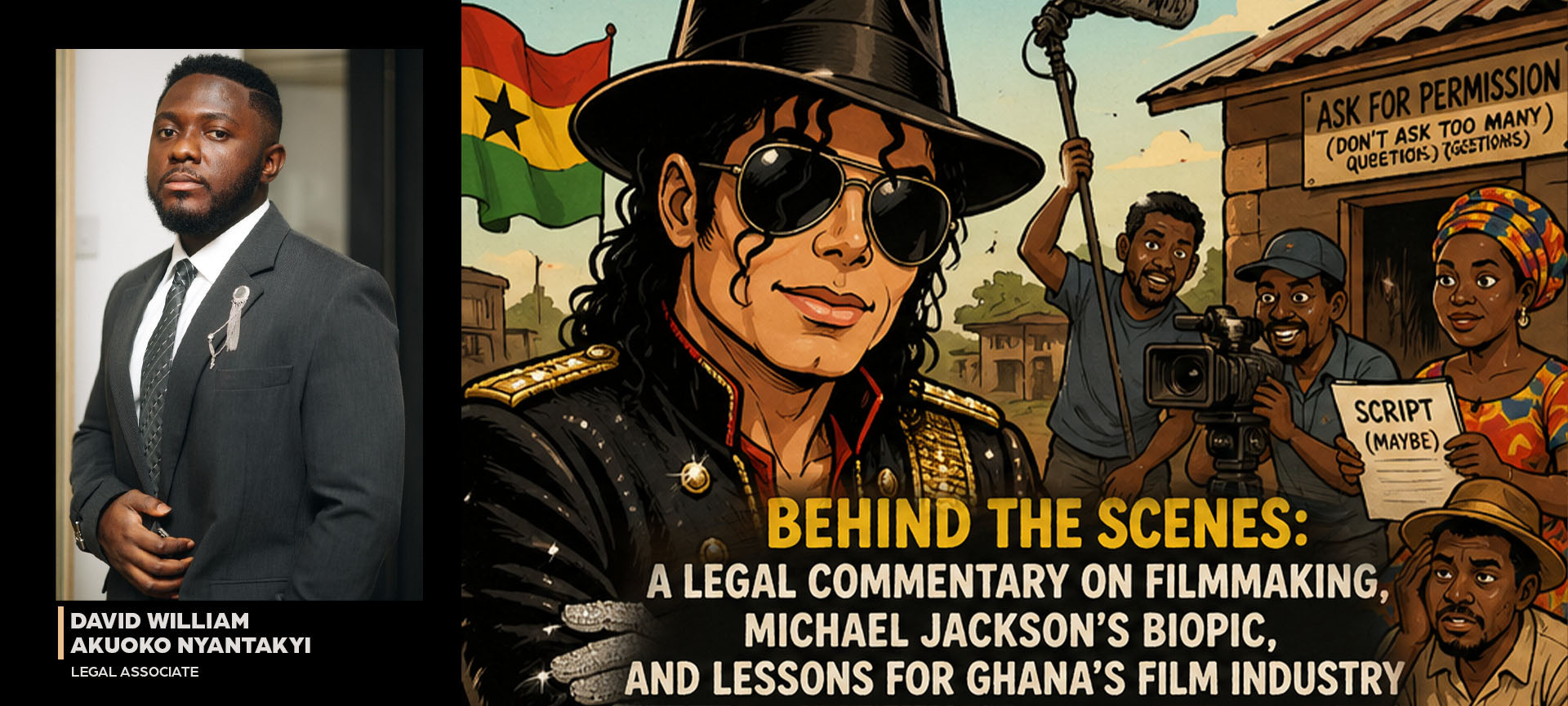
04 May Behind the Scenes: A Legal Commentary on Filmmaking, Michael Jackson’s Biopic, and Lessons for Ghana’s Film Industry
Introduction
In Ghana, films are not so much produced as much as they are survived. Remember that “baby-kick” in the “2016” movie trailer mocked on the Conan O’Brien show[1], where a baby sailed through the air with all the weight of a JPEG? A chase scene in a Kumawood movie could suddenly become less of an escape and more like a guided tour of the same “evil forest”. That slap across a poor househelp’s face that sounds like a thunderclap announcing divine intervention. Even some houses in Ghallywood have reputations, because they recur across multiple films like overworked actors who never quite get a day off.
A script appears (if at all), sometimes finished, sometimes still negotiating with itself. The producer gathers people: a director who “gets it”; an actor who owes him a favour; a location owner who can be convinced; an artist who is just delighted to have his song featured on-screen; and a camera that may or may not behave like it was paid. Rushed scripts, compressed production timelines, logistical shortcuts… Things move fast. Too fast for legal paperwork. Permissions are implied. Agreements are mostly verbal and rights are assumed. The production is carried out on trust, memory, and a shared belief that once the film is done, the world will somehow arrange itself around it.
The jokes about Ghana’s movie industry are unending. They persist because they are familiar and because they allow Ghanaians to participate in a kind of affectionate ridicule. But underneath all the humor lies something less amusing. The jokes reveal an industry that is creative, vibrant and resourceful, but often operates without the technical depth, financial stability, and legal discipline that underpin more mature movie industries.
It would, however, be wrong to assume these challenges are unique to Ghana. In Hollywood, films are constructed with meticulous attention to legal detail, supported by layers of contracts, clearances, and insurance. Every single risk is anticipated, documented, and priced. Or so it seems… Because even in such a sophisticated industry, a film as heavily financed and scrutinized as “Michael”, encountered significant legal complications arising from a clause buried in an old settlement agreement. Scripts were rewritten. Scenes were reshot. Release timelines were shifted, and the financial costs were substantial. This means even in Hollywood, with all the money, expertise and legal infrastructure in place, things can still go wrong.
This article proceeds from that premise. It examines the legal framework underpinning film production, using the complications surrounding the high-profile, biographical film or biopic Michael as a point of reference. This article further explores the legal risks in filmmaking, the need for confronting such realities early, and the ultimate consequences of neglecting such risks. More importantly, it asks what lessons can be drawn for Ghana’s film industry, which is rich in creativity but still developing its legal and commercial discipline.
The Legal Nature of Audiovisual Works
Films, music videos, animation, video games and TV commercials are all examples of audiovisual works. However, an audiovisual work is not merely a collection of scenes or performances. Under section 76 of Ghana’s Copyright Act[2], audiovisual work is defined as a work consisting of a series of related images which impart the impression of motion, with or without accompanying sounds. Though Copyright law is territorial, this definition of audiovisual work is widely accepted and reflects what is more commonly described as a motion picture. (As a brief aside, the word “movie” is actually just a shortened, casual version of “moving picture” that became popular in the early 20th Century.) Nonetheless, at its core, motion picture or film is a legal construct.
An audiovisual work is not created by a single author in the traditional sense. It is a collaborative work that draws from multiple sources of intellectual creation, including: literary works; musical works; artistic works; and performances. Accordingly, it is within this context that the concepts of authorship and ownership become critical because each of the aforementioned components is capable of independent copyright protection.
Generally, under the Copyright Act, the author of a work is the person who creates it. However, in the case of cinematographic works, the “author” is defined as the person by whom the arrangements for the making of the work are undertaken.[3] In practical terms, this designates the producer as the default author, and by necessary implication, the initial owner of the economic rights in a film, though not the moral rights per se.
This distinction is important because copyright comprises two principal categories of rights: economic rights and moral rights. Under the Copyright Act,[4] an author has an exclusive right to exploit a work commercially by reproducing, distributing, performing, and adapting the work. In the context of film production, these economic rights form the basis of all revenue-generating activities, from theatrical releases (cinema) to digital streaming on platforms such as Netflix and HBO.
Moral rights, on the other hand, are more concerned with the personal connection between the author and the work. They include the right of paternity (right to be credited), and the right to object to derogatory treatment of the work. Unlike economic rights, moral rights are generally not capable of assignment,[5] although they may be waived in certain circumstances. This distinction creates a subtle tension in film production because although the producer may control the commercial exploitation of the film, the various collaborators may still retain certain rights in relation to their contributions.
To avoid such fragmentation of rights in the movie industry, producers rely heavily on carefully drafted agreements that transfer economic rights from each contributor to the producer. At this juncture it is important to consider the legal concept of commissioned or employed authors in Ghana, which is popularly known as “work-for-hire” in jurisdictions such as the United States. Section 7 of the Copyright Act provides that the economic right of a work shall vest in an employer or a person who commissions the work where the employed or commissioned author has created the work in the course of the employment or commission. In simple terms, the person who pays for the work is treated as the owner of it.
In the context of film production, if the producer hires: a writer to write the script; a composer to make a soundtrack; or an actor to perform, then the producer ends up with ownership and control of the film. The work-for-hire doctrine is vital for the film industry because it allows a film to exist as a single, unified work capable of commercial exploitation. Without it, films would be a legal mess and the various contributors could block the distribution of the movie. It must be emphasized, however, that this explanation of the work-for-hire concept has been deliberately simplified. In practice, the extent to which collaborators relinquish their rights depends largely on bargaining power because some may negotiate more favourable terms, including profit participation or royalties.
Pre-Production Reality
As explained earlier, a producer often needs the assistance of a wide range of contributors to bring the script to life. Screenwriters, directors, actors, composers/musicians, location owners, visual artists/VFX teams, cinematographers, costumers, makeup artists, and financiers, among others. The reality of pre-production reveals how complex filmmaking can be, because without aligning these various contributions through a network of contracts, a film may be creatively complete, but legally defective. These networks of agreements are often structured as work-for-hire arrangements. Some arrangements with the key contributors to film production are examined below.
The Source Material Owners
Every film tells a story. That story may originate from a novel, an original screenplay, or may even be based on someone’s life (biopic). The source material for movies are often literary works such as novels and screenplays. Where the screenplay is original, the producer typically engages a screenwriter on a work-for-hire basis, to ensure that the rights in the script vest in the producer. When the film is adapted from a novel, the producer must obtain the necessary rights from the novelist, often through: option purchase agreements; assignments; or derivative licences. Examples of some popular movies adapted from novels include Harry Potter by J.K. Rowling, The Witcher by Andrej Sapkowksi, and Beast of No Nation by Uzodinma Iweala.
The requirement for such agreements reflect an important development in copyright law. Historically, copyright protection for literary works was understood in a narrow sense; safeguarding against the direct reproduction of the texts on the pages of the book.[6] Over time, copyright law has evolved to recognise the underlying commercial value of a literary work, such as the story and its distinct characters.[7] As a result, the law expanded to protect not only the text, but also its adaptation into other forms of expression.
In the case of biopics, additional considerations arise, including life rights agreements and, estate approvals if the person is deceased. Failure to secure these rights properly can expose the production to significant legal risk, particularly in relation to defamation and privacy claims. This will be elaborated on in the section regarding the Michael biopic.
The Director
The director is responsible for visualizing or bringing the source material to life by guiding both cast and crew. Despite this central creative role, the director does not typically own the film. Instead, the director is often engaged on a work-for-hire basis and the agreement spells out relevant terms including remuneration, scope of creative control, and the extent of any profit participation. The extent of profit participation heavily depends on the director’s bargaining power. Directors are often paid a fixed fee, however, certain bonuses may be negotiated if the director has star power or if the movie is very successful at the domestic or international box office. Additionally, the director may retain moral rights, particularly the right to be credited. Some well-known Hollywood directors include Martin Scorsese and Zack Snyder; whereas examples of popular Ghanaian directors include Shirley Frimpong-Manso, Kwaw Ansah, and Ivan Quashigah.
The Actors
Actors contribute performances that are integral to the film’s commercial and artistic value. However, just like directors, actors are typically engaged on a work-for-hire basis and do not ordinarily retain ownership of the film. The extent of an actor’s profit participation also depends on bargaining power, or their membership of a union. Examples of such unions include the Screen Actors Guild (now known as SAG-AFRA) in the United States, and the Ghana Actors Guild. Actors may leverage on the existence of the aforesaid factors to negotiate for backend percentages, bonuses, merchandise royalties or residual payments where the film continues to generate revenue. It must be emphasized that in Ghana, compensation for actors is largely contractual as the union system for actors is weak, in comparison with more developed countries.
Film Composers and Musicians
The music used in movies require multiple permissions due to the complex nature of musical works. Where music is specially commissioned for the film (an original score or sound track), the film composer is typically engaged on a work-for-hire basis. However, when existing music is used, the producer must obtain: a synchronization (sync) licence from the owner of the composition (songwriter or publisher); and a master use licence from the owner of the sound recording (artist or record label). If the record is a controlled composition, a master use and sync license may be executed as one agreement. The distinction between master rights and publishing rights is critical in this regard, as each right is owned and licensed separately, and failure to obtain both can result in infringement. For an extended discussion on this topic, reference is made to my article addressing the distinction between master rights and publishing rights.[8]
Location Owners
In 2025, popular musician Bad Bunny was sued by 84-year-old Puerto Rican homeowner, Roman Carrasco Delgado for over $1 million, for unauthorized use of his home in a music video and concert, without proper consent.[9] Against this backdrop, consider a movie producer who has just cleared a film’s soundtrack, only to discover that even the film’s setting has its own terms. In movie production, locations can be just as unforgiving because they are not merely physical spaces; they are also legal interests. Producers typically obtain permission to use private property, through location release agreements or permits. These agreements govern: the scope and duration of access; permitted uses of the location in the film, and liability for any damage caused during production. Without such permissions, the producer risks claims for breach of privacy, trespass, or unauthorized commercial use of private property.
Investors and Financiers
From blockbuster films such as Star Wars: The Force Awakens with a production budget of approximately $533 million,[10] to the neighbourhood independent filmmaker working with a budget of meat pie, Fanmilk, and vibes, no film is made without financing. Investors and financiers provide the capital necessary for production and in return, acquire defined financial interests in the distribution of the movie. These relationships are governed by investment or financing agreements, which typically address: the structure of the investment; recoupment mechanisms; and profit participation.
Movie financiers may be major studios, distribution companies, banks, or high net-worth individuals. In many cases, these investors may require a substantial degree of control or oversight, because their major concern is whether the film can legally be completed and commercially exploited without exposure to liability. This is where Errors and Omissions insurance (E&O insurance) becomes essential.
E&O insurance is a specialised form of professional liability cover that protects filmmakers against claims alleging infringement or misconduct arising from the film’s content.[11] These claims may include defamation, copyright infringement, trademark misuse, invasion of privacy, or unauthorised use of likeness or property. In practice, major distributors or studios often require an E&O insurance policy or certificate before the film is released to the public. This shifts the legal liabilities away from them and onto the insurance company. However, the insurers will only issue coverage once the producer demonstrates that all necessary underlying rights have been properly cleared, including script rights, music licences, and location releases.
Post-Production and Distribution
While post-production is often associated with editing, scoring, and other technical refinement of the film, its true legal and commercial significance lies in what happens after the completion of the movie. If the pre-production process is handled properly, the transition into production and distribution is relatively seamless. However, if it is neglected the consequences often surface later, at a far greater cost.
Once production is complete, producers typically partner with distributors who market and explore various avenues of commercially exploiting the film. As elucidated above, distributors will typically require an E&O insurance policy before releasing the film. Once the film clears this threshold, it may be exploited through multiple distribution channels, each governed by distinct licensing and commercial arrangements.
Revenue Streams in Film Distribution
- Theatrical Releases: Here, the producer licenses the distributor to generate revenue through ticket sales at cinemas or other venues for exhibition of movies. The distributor then makes separate exhibition agreements with the cinemas or exhibitors, and the revenue is split between the cinema/exhibitor, and the distributor. Typically, the distributor gets a larger share in the opening weeks, and the cinema’s share increases in later weeks. The distributor then recoups fees and expenses before passing revenue on to the producer.
- Physical Sales/Rentals: Although this has notably dwindled in relevance, DVDs and other physical formats continue to generate revenue in certain markets through retail and rental. The distributor often manufactures and sell the DVDs in bulk to video stores and other retailers at a wholesale price.
- Digital and Streaming Platforms: When attendance at the cinemas begin to decline, distributors explore digital distribution through streaming licenses with platforms such as Netflix, HBO, Amazon Prime Video, and YouTube. Most of these platforms are subscription-based, and in recent times have become dominant channels for film distribution. In some cases, movies are released exclusively on these digital platforms.
- Television and Cable: Similarly, after the theatrical release, the distributor may license television and cable networks to broadcast the film to the public. Usually, these broadcasters acquire the right to transmit the film only within a defined territory and time period, under a licensing agreement with the distributor.
- Soundtrack Distribution: The original soundtracks from a movie can also be commercially exploited through digital distribution on streaming platforms such as Apple Music or Spotify; or through other means of exploiting the master. The underlying composition would typically be monetised through publishing deals.
- Merchandising: The film may also generate ancillary revenue through merchandising or derivative licensing of products that are tied to the characters, themes or imagery from the film. For example, Warner Brothers may license a toy company to manufacture action figures of “Batman”, or license a clothing company to make Batman-themed shirts, for an upfront fee or royalties on every product sold.
The Michael Biopic
Michael Joseph Jackson, also known as the “King of Pop”, remains one of the most influential and commercially successful figures in pop culture and modern entertainment history.[12] His life was marked by extraordinary artistic achievement, global fame, and (unfortunately) major public controversy. It was therefore no surprise that his estate approved the production of Michael, a biopic that seeks to chronicle his life, career, and legacy.[13]
The film was conceived as a comprehensive portrayal of Jackson’s journey, from his early years with the Jackson 5 to his emergence as a global icon. Unfortunately, the original plot of the movie intersected with sensitive and controversial aspects of his life, including the infamous pedophilia allegations involving Jordan Chandler, which were resolved through a settlement agreement in 1993. The settlement agreement reportedly contained provisions prohibiting the dramatization of the Chandler family in any future works.[14]
This restriction became a significant legal obstacle during the production of Michael because it was raised by the lawyer for Michael Jackson’s estate after a substantial portion of the film had already been shot, reportedly during post-production.[15] The production company was forced to rewrite key portions of the script, because they had included the prohibited events. Additionally, there were major reshoots and deletion of certain scenes, which all carried serious financial implications. These reshoots and rewrites reportedly made the production of Michael incur additional costs estimated between $10 million and $15 million.[16] Most importantly, these setbacks affected the film’s release timeline. The distributor, Lionsgate, had to push back the original release date from April 2025 to 24th April 2026.
Lessons for the Ghanaian Movie Industry
For stakeholders in the Ghanaian film industry, particularly within Ghallywood and Kumawood, this article is not merely an examination of how films are made. It is important because it innately discusses how movies fail and how those failures can be anticipated. The legal complications surrounding Michael are instructive in this regard, and some lessons may be gleaned below.
Contracts Must Replace Assumptions
The reliance on informal arrangements remains one of the most significant vulnerabilities within Ghana’s movie industry. Verbal agreements, implied permissions, and “understandings” may be expedient or facilitate speed. But to what end? Every contributor to a film, whether a screenwriter, director, actor, or composer, introduces a potential legal interest. Without properly drafted agreements to define and transfer those interests, the producer risks fragmentation of rights and ultimately, an inability to distribute the film. The clarity provided by paperwork at the outset is invariably less expensive than the cost of resolving disputes at the end.
The Producer’s Need for Legal Architecture
The producer is effectively the central figure in the creation of the movie and his role extends beyond financing and coordination. Therefore, the producer’s responsibility requires not only creative vision, but legal awareness. Without proper legal assistance, the producer cannot effectively harmonize all the respective rights of the various collaborators. Producers must understand: the nature of the rights they are acquiring; the limitations attached to those rights; and the consequences of failing to properly secure them. Without this legal awareness, the production process becomes a ticking time bomb.
E&O Insurance and Industry Standards
As Ghanaian films increasingly seek international distribution, adherence to international standards can no longer be treated as optional. The limited use of E&O insurance within the Ghanaian film industry reflects a broader gap in risk management practices. Distributors and major streaming platforms are unlikely to engage with films that do not meet basic legal and insurance requirements. While such insurance may appear costly or unnecessary in low budget or independent productions, it serves a critical function.
The Michael case study demonstrates that even in a highly sophisticated movie industry like Hollywood, legal risks can remain latent until later in the filmmaking process. By the time the Chandler restriction was identified, the cost of resolving the issue had already escalated. This is where the relevance of E&O insurance becomes necessary because it not only provides protection against claims arising from such issues, but also signals that a film has undergone a minimum degree of legal scrutiny. Therefore, the role of legal due diligence and adherence to international standards at the pre-production stage cannot be overemphasized.
Budget Constraints Do Not Eliminate Legal Risk
In Ghana, productions are often executed under time and budget constraints. A recurring justification for limited legal structuring is cost. However, the absence of legal safeguards does not eliminate risk. It only defers risk. The reality is that this excuse is not acceptable if the ultimate goal of the industry is international recognition. Rights clearance, particularly in relation to scripts, music, and image rights, must be treated as foundational and not an afterthought. The experience from Michael demonstrates that even well-funded productions can incur substantial financial losses when legal issues are identified late. Ultimately, regardless of how compelling a film’s creative concept may be, investors are more confident in financing a project when legal safeguards are in place, and professional standards are upheld.
Conclusion
Ghanaian films have long been celebrated for their ability to exist against all odds. The improvisation, the speed, the shortcuts – this resilience in production is admirable. But it is also misleading because survival is not the same as structure. A film can survive production and still fail in every way that matters commercially. Short clips of the movie could go viral on the internet and it would still be commercially underexploited.
The contrast with more developed film industries is not that mistakes do not occur. The difference lies in when those mistakes are anticipated or discovered, and how much it costs to resolve them. Adherence to international standards is what determines whether a film can attract proper financial investment and generate sustained revenue. Furthermore, without a proper legal framework for a film, the work merely becomes a collection of performances and intentions, loosely held together by hope.
Unfortunately, hope is not a reliable form of legal protection.
Author:
David William Akuoko-Nyantakyi
(Legal Associate)
[1] Team Coco, ‘TJ Miller’s Favorite Insane Movie Trailer, CONAN on TBS’ (YouTube, 5th May 2015) https://www.youtube.com/watch?v=T9fAvodw2D4, accessed 21 April 2026.
[2] Copyright Act, 2005 (Act 690)
[3] Ibid, Section 76
[4] Ibid, Section 5
[5] Ibid, Section 9(1)
[6] See cases like University of London Press Ltd v. University Tutorial Press Ltd [1916] 2 Ch 601 (Ch)
[7] DC Comics v. Towle 802 F 3d 1012 (9th Cir 2015)
[8] David William Akuoko-Nyantakyi, ‘“Distro” or “Publishing”? The Difference, and Why Aspiring Musical Artists Need to Know It’ (Mondaq, 6 June 2024) https://www.mondaq.com/publishing/1333170/distro-or-publishing-the-difference-and-why-aspiring-musical-artists-need-to-know-it accessed 20 April 2026
[9] Austin Williams, ‘Bad Bunny sued over use of iconic house in video and residency’ LiveNOW from FOX (18 September 2025) https://www.livenowfox.com/news/bad-bunny-lawsuit-puerto-rico-house accessed 21 April 2026
[10] Caroline Reid, ‘Star Wars: The Force Awakens Becomes The Most Expensive Movie In History’ (Forbes, 26 February 2023) https://www.forbes.com/sites/carolinereid/2023/02/26/star-wars-the-force-awakens-becomes-the-most-expensive-movie-in-history/ accessed 22 April 2026
[11] Carbon Arc Media, ‘E&O Insurance: What Producers Need to Know’ https://carbonarcmedia.com/blog/delivery/eo-insurance-what-producers-need-to-know.html accessed 22 April 2026
[12] ‘Michael Jackson’ (Wikipedia, 2026) https://en.wikipedia.org/wiki/Michael_Jackson accessed 22 April 2026
[13] ‘Everything to Know About the Michael Jackson Biopic’ (Entertainment Weekly, 2025) https://ew.com/michael-jackson-biopic-release-date-trailer-cast-11844985 accessed 22 April 2026
[14] ‘Can a New Biopic Change Your Mind About Michael Jackson?’ (The Guardian, 2026) https://www.theguardian.com/music/ng-interactive/2026/apr/18/michael-jackson-biopic-jaafar-jackson accessed 22 April 2026
[15] ‘Michael Jackson Biopic Likely Delayed by a Year After Reshoots’ (People, 2025) https://people.com/michael-jackson-biopic-likely-delayed-by-a-year-after-news-of-major-reshoots-11740703 accessed 22 April 2026
[16] Brent Lang, ‘Inside the “Michael” Overhaul: $15 Million Reshoots, Removing Child Abuse Allegations and What’s in Store for Sequels’ (Variety, 7 April 2026) https://variety.com/2026/film/news/michael-movie-reshoots-removing-child-abuse-allegations-1236710221/ accessed 22 April 2026